Blog

  • Tips for making it through Covid-19 concerns while your children are at home

    By Tammi Pitzen, Executive Director of the Children’s Advocacy Center of Jackson County

    The Coronavirus has become a pandemic crisis impacting every aspect of our lives.  Parents are being forced into the role of educator as our children are pushed into a home-schooling situation.  To add to that stress, many of us do not know how long we will have a paycheck or a job, as so many industries are having to reduce operations or shut down completely.  We are being asked to limit contact with others. 

    All of this is causing anxieties to rise in both adults and children. 

    Be mindful that your children are looking to you to see if they should be scared. Do not completely ignore what is happening.  Answer your child’s questions in an age appropriate way.  Develop a new routine so that your child can feel safe.  Talk to them about taking the recommended precautions to stay healthy. 

    Additionally, do a daily “worry” check in. 

    With my child it goes something like this, “Let’s check in.  Tell me something you are worried about today?”  or “Are you concerned about anything today?”  It is enlightening what you may find out.  Many days those concerns have nothing to do with what is currently happening and many times it is something that a parent can address easily.  The latter is great.  It gives you a boost in your confidence level as a parent and your child is reassured that things are okay.  Soon, you may find that your child is initiating the daily check in.  “Hey Mom!  Tell me how your day went?  What made you happy today?”  At my house, we change the questions up.  Sometimes worried focused questions, sometimes feelings focused questions and sometimes activity focused questions.

    Here are some ideas for activities that you can do to keep your child engaged and to help with your own self-care during this unsettling time:

    • Read a book aloud. My child’s class has read-aloud time during the school day and it is something he enjoys.  Pick a series and read together for thirty minutes a day.
    • Do an art project together. Draw, make slime, finger paint, color—build with Legos.
    • Write a “book” together. Develop a story line, take turns writing paragraphs, create illustrations.  It can be a true or fantasy.
    • Take a hike. Go someplace and enjoy nature together.
    • Watch a movie or find a series on Netflix or Amazon Prime that is family friendly. Gilligan’s
    • Bake or cook with your child. This helps to develop math, reading and survival skills.
    • Teach your child to clean and disinfect.
    • Play outside…basketball, catch, blow bubbles, hide and seek, take a walk.
    • Play tic tac toe, board games, card games, or make up your own game.

    Structure can help get you through this crisis and as a bonus the “together time activities” will help to strengthen family bonds.


     

    Image of Tammi Pitzen
    Tammi Pitzen
  • Center Open, but limited to Emergency & Crisis Situations

    Center Open, but limited to Emergency & Crisis Situations

    IMPORTANT MESSAGE

    The Children’s Advocacy Center of Jackson County will remain open but limited to emergency and crisis related situations.   Our therapy department will be moving to providing services by phone or a HIPPA complaint web based platform.  This week most appointments were cancelled in order to work out a process to move in a way to be able to continue to provide interventions in a safe way.

    We will continue to schedule, on an emergency basis, forensic interviews.  As always these will be scheduled through law enforcement or child protection and we will work those entities to do so in as timely and in accordance to CDC recommendations.  We will be evaluating this daily based on the latest recommendations and what we learn about the spread of COVID 19.  “Emergency Basis” is being defined by law enforcement and child protection protocols and the ability to secure safety of the child needing the interview.

    We are increasing our cleaning of our building wiping down surfaces throughout the day.

    We are going to a smaller staff being on site at any given time.  If the phones ring longer or go to voicemail more frequently please be patient.

    We know that child abuse does not stop for any reason and we are working on being as responsive as we can and still help stop the spread of  COVID 19.

    We will be limiting the number of people in our work spaces.  What that translates to is we are trying very hard not to have more than one family in our building at one time.  NO ONE will be allowed in the building who is currently ill, running a fever or has had flu like symptoms in the last five days.

    We are not accepting donations of any used or gently used items at this time.  We are accepting snacks that are prepackaged by the manufacturer (i.e. goldfish, animal crackers,  etc.)  While we are not serving the usual number of children, we will be very soon have an increase once the CDC recommendations are lifted.

    We are also accepting donations of cleaning supplies such as Clorox, Lysol, or cleaning wipes.  These are in high demand.  We have some supplies right now but like you are uncertain how long this may be a need.  We are not assembling a stockpile of any supplies which means at the rate we are going we will run out.

    Additionally we are accepting gift cards in ten dollar increments to grocery stores in order to help out the families we serve who may not be receiving an income right now or may be facing reduced income or will need help with food even after the immediate concern is lifted.

    At this time all Protect Our Children trainings are cancelled or postponed.  After April 15th we will reevaluate based on the most current recommendations from the Governor and CDC at that time.

    Thank you

    Tammi Pitzen, Executive Director of the Children’s Advocacy Center of Jackson County

  • Thirty Stories from Thirty Years: Story Number 2

    Thirty Stories from Thirty Years: Story Number 2

    By Tammi Pitzen, Executive Director of The Children’s Advocacy Center of Jackson County

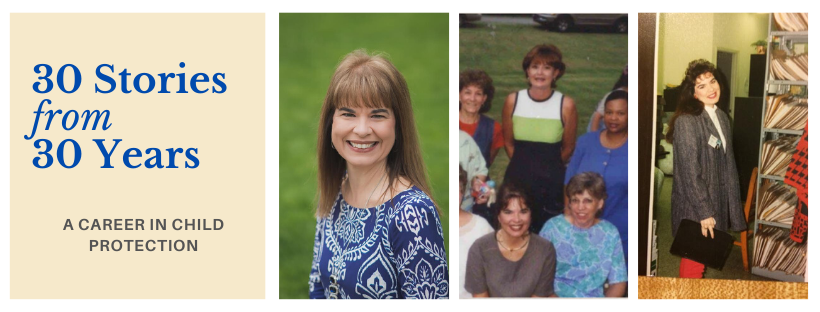
    This is story #2 in Tammi Pitzen’s series of 30 stories from her 30 years working in child welfare.

    You can read all the stories here.

    For me, this reflection on my journey is more about examining moments in time that helped me to build my resiliency, than merely telling “war stories”.  Things that allowed me to continue and strengthen my self-care skills.

    I want to just acknowledge some things that my training did not prepare me for in anyway.  I chuckle as I think some of this is still missing from general “core” training that many child protection workers are required to complete in order to start “field” work.  In my case my core training was all about Geno-grams, and how to ask questions that motivate families to do better.  All good stuff, but did not prepare me for the nitty-gritty everyday work.

    1. In no way was I totally prepared to recognize and respond to threats against my safety.

    I remember my very first “serious” level two case.  It involved a child with what appeared to be a burn on his arm.  It was in a very rural area of our very rural parish.  It was not uncommon for families out in literally nowhere cow pasture Louisiana to live in shacks made of particle board.  In fact, for laborers who worked on the farms, it was quite common.  It was part of their pay. 

    I had already talked with the child at the heart of this report at school and made my way to the “house”.  When I arrived I was greeted by a very angry tall man cleaning a rifle of some sort on the front porch.  The school had somehow gotten in touch with him to let him know I was on my way out.  I still haven’t figured that one out.  He did not have a phone.  It was light years before cell phones were a common and there were no neighbors for miles.

    I took a deep breath. I got out of my car, stood tall and flashed the biggest smile I could and introduced myself.  I was in heels, pantyhose, and a dry clean only dress, trying to balance my state-issued black Day-Timer and yellow legal pad so I would be able to take whatever notes I thought I might need to take. The dress and panty hose at that time were pretty much the expected dress of any female state employee. 

    He was a large man decked out in plaid flannel, jeans, and worn cowboy boots.  His first words after I introduced myself was, “Do you know that I can hit the bullseye on that target 100% of the time?”  I turned around to look at a target that was pinned on a tree a fair distance off.  Without skipping a beat, I smiled and said “Wow that is impressive! Maybe you can show me after we finish talking?”  I looked him in the eye and stood my ground.  We went inside completed our business and as I was leaving he offered me some iced tea.  I politely declined, even though I had “cotton mouth” from what I probably would recognize now as anxiety. 

    The whole time I was in this shack, I was trying to plan escape routes.  I had made the mistake of going in and allowing him to enter behind me.  There was one window and I was hoping against hope that I could run and jump out if I needed to, as he had positioned himself between me and the only exit.  When I returned to the office to staff the case with my supervisor, she asked me why I didn’t leave.  She said you should have left.  I sort of laughed and said, “No one told me that was an option.  I assumed I was going to have to get some answers about what happened.”   I did not want to have to work with this family and he think I was scared of him. 

    Which leads me to:

    2. In no way was I prepared to have to leave kids in situations where I was pretty sure they had been hurt by their parent.

    In this particular case, the child was unwilling to tell me what happened.  The school was not cooperative with my investigation, but was very protective of Dad.  No one single person was able to tell me that the round spoon shaped burn on his arm was caused by anything other than an accident.  Even though I had followed every avenue to get that story.  Even though the child told me that he would get in trouble for talking to me.  I remember sitting in my supervisor’s office sort of flabbergasted that we were closing out that report as unsubstantiated with concerns.  I was equally surprised that no other reports came in on that family.  At least not while I was working there.  It could have been that it was an accident.  It could have been that having me on the front porch was as scary for the Dad as it was for me and that was enough of a deterrent.  I will never know which it was. 

    Which leads me to the caveat about learning self-care and building resiliency. 

    When working in such a volatile and trauma filled field, you need to always do the best that you can.  You need to always follow all the information to the end.  You need to always do your best work.  But when you have done all of that, and you are told there is nothing else you can do, you need to accept that and move on.  It’s harder that you think. 

    I never did the moving on part easily. 

    Part of how I dealt with that helplessness for a really long time was to hold my cases open past the permissible 60 days.  I argued a lot with supervisors regarding what I thought needed to happen.  Sometimes I got to move in the direction I wanted and sometimes I did not. 

    The best way to care for yourself is to know your lane and stay in it.  When you drift, you need to ask why you are drifting into someone else’s lane.  It may be vicarious trauma. 

    3. My core training never prepared me for the courage and integrity needed when working as an investigator of child abuse.

    You have to be able to do what is right even when no one is looking.  You have to be able to let the record be what the record is, even when that does not lead to the result that you feel is necessary.  This work demands that you not be afraid to see something all the way through and that you do so with grace, compassion, and empathy.  Anything else leads to global failure of the system.  You also have to do what is scary and right, even when it means you are working more than a 40 hour week, even when it means your paperwork is three times as much as it could be, and even when it makes you face things that are both personally and professionally hard.  To do anything else leads to global failure of the system.  The risks are high.  The rewards are beyond what you can imagine.

    4. My core training never prepared me for the amount of politics that are at play in the child abuse field.

    I am leaving number four as it is for now.  The story behind the lesson learned will wait for another day. 

    The thing I hope that those who work in this field take away from this…is that it is okay to take care of yourself. 

    Not only is it okay, it is required.  You need to set and enforce boundaries that are reasonable.  You need to recognize that sometimes those boundaries will result in you changing employment maybe even leaving the field.  The truth of the matter is the work is the work.  It isn’t for everyone and that is okay too.  There isn’t much that can be done to make it easier.  Organizations, state departments of social services, and other agencies that provide a service or intervene in child abuse are not at liberty to not respond because they are over capacity.  Recognize that.  Recognize that it is okay to say no.  Recognize it is okay to say yes. 

    In the end only you can decide what is okay for your own health. 

    If you are a supervisor working in this field, the thing I hope you take away from this is to always respond with empathy.  When your staff messes up, help them learn and move on.  Sometimes staff needs to hear from you what safety means because like me, they may not fully recognize what unsafe is. 

    Set a culture in your office that allows for self-care. 

    And…remember the work is hard.  The work is what the work is.  We can’t make it easier.  We can help people take care of themselves.

    Lastly, if you are a regular Joe, a regular citizen, recognize the system is flawed. 

    But also recognize that it isn’t something that one person working in your local child welfare office will be able to resolve. Recognize that, as in all walks of life, you have really good workers and sometimes not so good workers.  Do not paint everyone working in the system with the same brush.  Recognize that sometimes those workers you are trashing on social media are the good guys.  Sometimes it is a system failure and not an individuals’ failure.   

    Sometimes that person that you are raging against is just as frustrated as you are.

    This is story #2 in Tammi Pitzen’s series of 30 stories from her 30 years working in child welfare.

    You can read all the stories here.

    #ThirtyFromThirty #30StoriesFrom30Years #ACareerInChildProtection

    Share This Story

  • Thirty Stories From Thirty Years: Story Number 1

    Thirty Stories From Thirty Years: Story Number 1

    Thirty Stories From Thirty Years: Story Number 1

    By Tammi Pitzen, Executive Director of the Children’s Advocacy Center of Jackson County

    This is story #1 in Tammi Pitzen’s series of 30 stories from her 30 years working in child welfare.

    You can read all the stories here.

    I quietly celebrated the beginning of my thirtieth year of a career in child protection a few months back. 

    I get asked a lot about how I have stayed the course so long in such a heart-wrenching field. 

    I used to think it was a rhetorical question and would flippantly answer, “If not me, then who?” And then all the studies and articles began coming out in “flooding” proportions on secondary trauma and compassion fatigue and I realized maybe they were sincerely wondering how I have continued and remained emotionally and mentally healthy. (Although I think there are days that some would debate this being true.)

    I am setting out to answer this in a series of posts by telling stories from my career that were pivotal in moving me forward, timidly at times and forcefully at others, through the murk of the stagnating swampy waters of vicarious trauma. 

    My career began before I realized it had begun.  It is almost like this “thing” — greater than myself — picked me and here I am. 

    Picture this…(If you are a Golden Girls fan from back in the day, you totally get this reference. If you are not…skip over it—indulge me in my 80’s reference and read on.) It is 1988, in the fall semester of my second year of college.  I am sitting in an auditorium waiting for the first installment of my Child Abuse 101 class to begin.  Yes.  It was called Child Abuse 101.  There were about 50 students in this class.

    It was an easy elective for Social Work or Sociology majors.  There was lectures, lots of discussion on social issues, and many, many slides of abuse related pictures and graphs.  My entire framework on which the foundation of my life so far is about to be turned upside down, only I didn’t know that yet. 

    I was raised in a very conservative, very religious family in a very small community.  I was sheltered from a lot of the bad in this world throughout my childhood.  In that very first class, as I heard the statistical information on the rates of child abuse in this country and drilled down to my own state, I remember looking around and wondering why no one seemed shocked by this information.  I remember thinking, “How can this be true?” and “Why had I never met anyone who had been abused?” 

    I also remember looking back and putting the pieces together of stories I had heard in high school about classmates who no longer lived with their parents, and the reasons used to explain why were being shattered like glass hitting the ground.

    That may all seem a little dramatic, but in looking back, that “awakening” was THAT dramatic.  From that class on, most of my course work was weaved around child abuse and system interventions.

    And…so comes STORY NUMBER 1

    I completed my Social Work Internship in 1990 on a very cutting edge, as in maybe the first in the state of Louisiana, child abuse team at the Ouachita Parish Sherriff’s Office.  (That is pronounced “Washitall” for nonnative Louisianans.) 

    On my very first day on this team, I realized I was an adrenalin junkie and was hooked on the art of providing safety for children. 

    I had a very smart, strong, female detective as my role model of what I thought my career would look like.  I was sitting at my desk for only about 20 minutes before loading up in an unmarked police car to head out into literally the unknown areas of the parish to pick up a sex offender accused of molesting a young female child.  He took off into the nearby woods and all four officers, guns drawn, took off on a foot chase.  I did not participate in this chase, but quietly got back into the car and locked the doors.  This act was the source of much teasing and ribbing for the entirety of my internship.  However, I must point out that I was the only unarmed person there—even the offender was brandishing a fire arm.  Those two female detectives I was with came back out of the woods dragging that offender with the other two male cops “covering” them and I knew I had found “my people”. 

    I learned more about listening to children and understanding dynamics of child abuse in those four short months than I did in any of my social work classes.  I learned more humility, more compassion, and more empathy from that team of detectives than I did in three and a half years of college courses. 

    I also learned my first lesson in self-care.

    Never take yourself too seriously and always find something to laugh about every day.  Not at the expense of victims or even at the expense of perpetrators, but just something…anything.  Laughter is the best medicine. 

    I did not end up being a law enforcement officer as I had thought I would be.  I instead started my career as a Crisis Investigator with the State of Louisiana’s Office of Community Services in the very small town I grew up in, investigating, in some cases, parents that were my classmates in high school.  

    I literally graduated on a Saturday and started on the next workday.  There was a holiday or something in between.

     I took with me every lesson learned during my internship.  I never interviewed a child in those beginning days that I did not think of the soft gentle voice of my supervising detective reminding me of how the picture will be made complete if we pay attention to the little voice helping us to find the next piece of the puzzle. 

    Back then we were in the very early days of interviewing protocols. It seems odd to think there was a practice before there was a protocol.  It also seems odd to think of these protocols, and the dramatic change in how we do our work, happened in my career span.

    I always try to end my post with some call to action or some profound reflection.  Today I simply want to acknowledge that intervening in cases of child abuse is hard work. It takes a toll.  Self-care is not a luxury but a necessity.  For me it has always been about humor—not at the expense of others, but generally at my own quirky behaviors.  

    There is no special magical potion that provides you armor against all the hurts.  Find what works for you and build it into your life.

    29 more stories to go!

    This is story #1 in Tammi Pitzen’s series of 30 stories from her 30 years working in child welfare.

    You can read all the stories here.

    #ThirtyFromThirty #30StoriesFrom30Years #ACareerInChildProtection 

    Share This Story

  • What will be the final grade?

    What will be the final grade?


    By Tammi Pitzen, Executive Director of the Children’s Advocacy Center of Jackson County

    I came across an article posted on Facebook that talked about a woman who was suing her church because they did not warn her husband that, by confessing he abused a child, it would be reported and investigated. 

    The church (The Church of Latter-day Saints) is sticking by their decision to report and to protect a child. 

    The story goes that the husband confessed his “sins” to the pastor.  They did not warn her or her husband that they would report those sins to the authorities.  In this case, the sin was “engaging in inappropriate conduct” with an underage girl.  The church stands by their decision to protect this child and make the report.  The Church goes further stating that it teaches that its leaders and members should fulfill all legal obligations to report child abuse to authorities. They even have a 24-hour helpline to report abuse. 

    Let’s lay to rest any lingering thoughts about whether or not the offender was unjustly accused.  He was investigated based on his words – what he said he did.  In 2017, the offender was convicted and is serving 15 years in prison.

    First thought:  Bravo!

    I will put my disclaimer here.  I am not a member of the Church of Latter-day Saints.  However, I applaud their straightforwardness in protecting children.  Not only in action — but then also by the messaging they sent that they are standing behind that decision, even in the face of being sued.

    Second thought: I hope it was not her child. 

    Can you imagine the message this child is hearing if this is a family member? They are suing the church for 9.5 million for loss of income, emotional distress and the family’s loss of her husband’s companionship.  Also 40 thousand to cover his legal fees.

    In other words, those left unspoken….“You are not important.  Your abuse should be kept silent.  The offender’s status is more important.  You deserve to be abused.”  No support will likely send this child deep into silence.  And how unfair.  She/he did not report.  The offender did.  Let that sink in for a moment.  And if anyone has any questions about why the child did not report, research the story.  If this child is a family member his/her survival probably depended on keeping the secret.

    If it wasn’t her child, then there is a chance that the adults in this child’s life will be supportive and help the child find the path to recovery.  Let’s hope for this scenario.

    This happened in Oregon. 

    In Oregon, as is the case in 28 other states, clergy are among the professionals mandated by law to report known or suspected instances of child abuse or neglect.

    What is on the line?  Besides millions of the church’s monies? 

    This litigation if successful can push the church back into a cloak of silence.  We are barely dealing with all the abuse that happened behind the closed doors of our faith-based communities for the last five decades or so. 

    What would be the outcome of that cloak of silence? 

    Creating an environment where abuse is accepted, where the victim is shunned,.…hmmmm,  sounds vaguely familiar. Isn’t that where we have been working to move away from? 

    Basically this lawsuit, if successful, will essentially tell children, in all walks of faith, that the offender deserves the protection — not the child.

    What can be done?  I don’t know.  Anyone can sue for any reason.  This is a test I think. It could offer more safety to offenders or it could protect clergy who provide a pathway to safety, healing and hope for children being abused. 

    The final grade is going to change the world that I work in. The question is will it shine light on abuse or push it back into shadows?


    Tammi Pitzen
  • TAKE ACTION in 2020: Make a plan to do these 5 things to keep kids safe


    By Summer Lewis, Internet/Social Media Contractor for the Children’s Advocacy Center of Jackson County

    The beginning of a new year is a great time to regroup, reevaluate and recommit to a new plan of action for protecting your kids from abuse. By knowing what to do and making a few simple changes, you can effectively and dramatically reduce the risk your children will be sexually abused.

    Here are 5 actions you can take this year to jump-start your plan to prevent child abuse from impacting your family.

    1. BE AWARE:

    Begin by taking a critical look at your closest relationships — friends, family members, caregivers and any other adults in your child’s life. Accept the uncomfortable reality that your children are more likely to be abused by someone they know (and you trust.) Trust your gut and take action to minimize opportunities and/or remove any safety threats. Particularly avoid one-on-one child/adult situations. More here: https://www.d2l.org/education/5-steps/step-2/

    1. TALK:

    Talk openly and often about sexual abuse with your children. Use age appropriate language to talk about bodies and boundaries. Use everyday opportunities to start conversations. It can be awkward, uncomfortable and easy to put off. Don’t! If you need help about how to get started or what to say or do, visit: https://www.d2l.org/education/5-steps/step-3/

    1. STAY INVOLVED:

    Commit to staying closely involved with everything happening in your child’s life. Know and interact with every person that your child has contact with – other families, parents, teachers, coaches, any other adults and older children. Volunteer, participate, and attend. It will foster a closer relationship with your child, which is a protective factor for abuse, and it put predators on notice that you are watching. You can even tell people you have taken a child abuse prevention training and know how to recognize abuse, and that your child knows about body boundaries and to tell you if they are crossed.

    1. MONITOR:

    Keep computers in an easily view-able central location in your home. Have a rule that children may never give out this info online: name, phone #, email address, street address, password, picture, school. Remember internet technology can be mobile, so monitor cell phones, laptops, tablets and gaming devices. When it comes to internet safety, however, research shows that talking to kids about the reality and dangers of being online and teaching critical thinking is more protective than spying. For more on internet safety and discussion starters, visit: http://www.netsmartz.org/internetsafety

    1. GET TRAINED:

    Carve out some time for and commit to taking the short, free PROTECT OUR CHILDREN child abuse prevention training the CAC offers. You’ll learn about warnings signs of abuse, how to prevent abuse and how to react responsibly if you suspect abuse. Find out more and sign up for a training here: http://cacjc.org/trainings/protectourchildren/

    Congratulations on being proactive by creating an action plan to keep your children safe from sexual abuse!

    Summer Lewis


  • Mighty Together on Giving Tuesday


    By Summer Lewis, Internet Marketing Contractor for the Children’s Advocacy Center of Jackson County

    For a long time I was obsessed with wanting to work for this nonprofit in my community called, The Children’s Advocacy Center (CAC). I applied for their various job openings without success — until they needed a contractor to handle their social media and enewsletter work. I got the job and have been doing this work for them for almost ten years! 

    Ten years ago, however, I wasn’t self-aware enough to tie my obsession with working at the CAC to the fact that I was a child abuse survivor myself. Duh! 

    I see now that I yearned to be part of this miraculous place where children are helped daily — in the ways I had NOT been helped when I was a small vulnerable child. For example, the best I could come up with was to eat canned spinach so I could be strong like Popeye the Sailor Man — who I adored. (Not very effective, but I give myself credit for courage and creativity.) 

    For a few years now, I have been part of running a #GivingTuesday fundraising campaign. Giving Tuesday is December 3rd this year and our theme is “We Are Mighty Together. You Matter!”

    I know for a fact, having been there, counting on the power of spinach and Popeye, that kids can’t figure this out on their own. Kids simply can’t stop, prevent or heal child abuse by themselves.

    The only hope they have of being mighty is with the help of the adults in their families and communities. 

    Kids count on adults and the Children’s Advocacy Center counts on the community to help provide for kids. On #GivingTuesday the CAC is raising funds for the the direct services that help protect and heal kids — and support families.

    I encourage you to donate to the Children’s Advocacy Center, as you are able. No amount is too small. Every amount is a vote of confidence, supports kids, and bolsters families with a mighty impact. 

    Kids + Community + Children’s Advocacy Center = #MightyTogetherCAC

    When we All give together, we truly can be mighty together – including the kids!


  • A Thanksgiving Message From Our Executive Director


    Greetings from Tammi Pitzen, CACJC Executive Director

    Happy Thanksgiving to all of you on behalf of the Children’s Advocacy Center of Jackson County Board, Staff, Advisory Council, and volunteers! 

    As I am rush around today to try to get things wrapped up before the snow comes in and in preparation for a couple of days off for Thanksgiving, I am feeling so thankful for so many things! 

    I am thankful that I have the privilege and honor to work with a team who is incredibly talented, knowledgeable, professional, and compassionate…both on staff and as part of a larger multidisciplinary team.  This work is so hard and so important!  And so hard.  Let’s just acknowledge that.  So very hard. 

    I am so thankful that we have a community who prioritizes children and who is so supportive of the Children’s Advocacy Center of Jackson County, our programs and the abused children we serve.  We cannot do this work alone.  It takes a community!  Thank you so much for your time, talent and treasure.

    I am so thankful for our volunteers who do not have to be here but who show up week after week with a smile on their face eager to help in whatever way is needed.  That is really incredible when you think about that!  They don’t get a pay check.  Sometimes staff gets busy and forgets or misses an opportunity to say thank you!  The children are not always pleasant when they are here in a time of crisis.  Sometimes the parents are angry…but the volunteers keep coming and keep giving and continue to be empathetic and compassionate.  I AM SO THANKFUL for ALL of YOU!!

    We could not sustain this important work without all of you! 

    So Thank you!!!  Thank you!!  Thank you!!


    Tammi Pitzen
  • A Tale of Two Kids: Why CAC Matters

    A True Story by Tammi Pitzen, Executive Director of The Children’s Advocacy Center of Jackson County

    I want to tell you a story today of a child. A child that I know.

    She is not a child that had the benefit of receiving services through the Children’s Advocacy Center (CAC).

    But she is why I believe in the CAC.

    I met her when she was six. I was 22 and a child protection investigator. She was the most beautiful blond-haired blue-eyed child I had ever seen. I wish that I could say that the day I met her was the day that her abuse stopped. But that is not the case. I wish that I could say that I was the first child protection worker that she met. I was not.

    When I interviewed her about her abuse — she was silent. She could talk. She had ten seconds earlier called me some very colorful names that I am sure she had heard some adult in her life use to describe my comrades, the previous workers who had paraded in and out of her house.

    I visited her at her elementary school. She had been interviewed at school before. She had been interviewed in her home. She had been interviewed at other schools by other workers. The police had interviewed her on scene several times while responding to calls of domestic violence.

    She never spoke.

    Reports flowed in on a monthly, sometimes weekly basis. Soon the school counselor bypassed the reporting line and called me directly. She stopped me in the grocery store on the weekends. She called my home number. She had no one else to call.

    This child, this beautiful little girl, was described as feral in some reports. She had behavioral issues. She was aggressive. She screamed. She was dirty. She smelled so bad that her classmates would not sit next to her. She constantly had bathroom accidents—either because she could not control it or did not want to control it. She “binged” in the cafeteria because she was starving.

    I spent hours pouring over records — alone in my office. Across town, there was a doctor who was concerned as well. We were trying to figure it out with only the pieces of the puzzle that we had in front of us.

    It took six months to find enough “evidence” that she was at risk and that she and her siblings should be placed in DHS custody. In time we came to learn that, in addition to the years of physical abuse and neglect, she had been sexually abused by multiple family members. The last time I saw this child, she was 10 years old. She was getting therapy. She was in a special foster home. She had had three psychiatric stays in one of the best treatment centers in the country. She had blown through too many foster homes to count.

    Her story is a long and sad one. I carry it around in my heart and there are few days that I do not think about her. Not one incident of abuse committed against her was prosecuted.

    I want to tell you of another child. He too is a child that I know.

    He did have the benefit of the CAC.

    He was four when I met him. I was . . well, a lot older than 22. I met him when he visited me at the CAC. He came to tell his story. He entered very scared — clinging to his mom’s leg. He went into what I call “the little room”, which is an interview room equipped with audio and video recording equipment. He was very shy at first, but as he answered the questions and became comfortable and safe, he very BOLDLY told his story of abuse.

    His mom received support from the Center staff. He only had to tell his story one time and then one more time in court. He got to meet the DHS case worker, the police officer, and a very nice nurse. He called them his “team”. He left the CAC smiling ear to ear.

    He sat at the table talking to me. I will never forget a conversation that he and I had while eating animal crackers at a table. He asked me “What is this place called?” I told him that it was the Children’s Advocacy Center. “It’s a place that kids can come and talk.”

    He told me proudly, “I talked!”

    He sat there smiling at me for a minute. He then looked very serious and told me that he did not talk when the lady came to school. I reassured him that was okay. He told me that it was too scary to talk at school.

    He was seen for a medical exam. He shared with me that his body was okay! He then got an angry look on his face, and said that Jim “lied to him.” Jim told him that his body was “broken”.

    This young man came to court with his suit and tie on. He testified and did a fantastic job. He was six. After court he unbuttoned his shirt to show me that he had a superman t-shirt on. His offender is in prison today with very little hope of ever getting out again.

    What a contrast in these two stories.

    I have seen proof that when we as professionals work together we have better outcomes for our families.

    I have seen proof that in communities where CACs exists there are better outcomes for children, families and the community itself.

  • 10 ways to keep children safe from abuse this holiday season


    By Betsy Lewis, Social Media Contractor for the Children’s Advocacy Center of Jackson County

    The holidays are coming, and families and friends will be gathering together to celebrate.

    Unfortunately, the holiday season is also the time of year when all types of child abuse increase.

    And it is those we know, these very family members and friends, who are the ones most likely to abuse our children.

    Here are some startling facts:

    ·        90% of children are abused by someone they know.

    ·        80% of sexual abuse occurs in one child – one adult situations.

    ·        30% of all child sexual abuse is perpetrated by other youth.

    Put these facts together with the hectic holiday season, where adults and children are thrown together, regular schedules are in flux, parents are often stressed and distracted, and you can see why kids are at greater risk this time of year.

    How can you protect your children? Darkness to Light/Stewards of Children, the curriculum we use in our Protect Our Children Trainings, calls it “Minimize Opportunity”

    Here are suggestions for your holiday season that will minimize the opportunities for abuse:

    1.      Choose group situations and have multiple adults supervise children.

    2.      Scan the physical environment for hidden areas and correct dangers.

    3.      Make sure interactions are observed and interrupted.

    4.      Remember older youth should not be in isolated, one-on-one situations with younger children.

    5.      Talk to kids about body boundaries (immediately, frequently and all year long.) Tell them they do not have to give or receive hugs, kisses, or other affection. Tell them to talk to you if anyone crosses their body boundaries. If your child tells you that he doesn’t want to be around a particular person or participate in a particular outing, take her or him seriously.

    6.      Avoid one child – one adult situations. If you do have to leave your child alone with someone, make it “observable and interruptible.” Let the adult know that you could return at any time, that you and your child are educated about child sexual abuse and that you have taught your child to tell you if there are body boundary violations.

    7.      Have a household open door policy – no interior doors are to be shut.

    8.      Make sure all outings, games and activities are observable by you or others.

    9.      Make any interactions with older children observable by multiple adults.

    10.   Be aware of “roughhousing.” Know that tickling, poking the stomach, patting the butt or knees, rubbing shoulders, can all be part of the grooming process.

    This is a hard truth and can be difficult to hear and accept: You cannot trust anyone 100% and no one is exempt, not even the closest, most beloved family members.

    Additionally, be sure to manage your own stress level and drug and alcohol use so you can be alert and aware. Most importantly, go with your instincts. Pay attention and take the necessary steps to correct any dangers if anything bothers you about someone who spends time with your child.

    The best way to keep the holidays a beautiful and magical experience and memory is to take good care of you and yours. You matter!


    Betsy Lewis