This is a post by Karen Bassett, an RN for over 30 years — the past 20 years at Southern Oregon Pediatrics of Medford, Oregon.
The proverb – “It takes a village to raise a child” – means that the work of raising a child cannot be done alone; rather, an entire community must participate.
As far back as I can remember, I have had a love for working with children. During my pediatric rotation in nursing school, I discovered this passion could be merged with my career. Not only could I spend hours working with children, but I could also help teach them and their parents. My patients have ranged in age from birth through the early college years.
Teaching and empowering children and families is the most rewarding career.
Living in the Rogue Valley, we are fortunate to have access to many resources that are available to children, teens, and their families. These include respite nurseries, parenting classes, after school programs, charter schools, hands on museums, centers for counseling, speech and physical therapies, and so much more.
As I spend many hours each week coordinating care for my patients and their families, I am reminded of the many dedicated people working to create healthy caring children and families. These professionals and volunteers reassure kids and families when things are a part of growing up, and also help when extra help is needed.
I feel privileged to be part of the “village” working with families and children in the Rogue Valley……. helping each child reach their full potential!
By Tammi Pitzen, Director of the Children’s Advocacy Center of Jackson County
Recently I spent time learning about child sex trafficking in the United States. Sex trafficking is the most common form of modern-day slavery.
Estimates place the number of domestic and international sex trafficking victims in the millions.
Most of the victims of sex trafficking are females and children. It is the fastest growing business of organized crime, and the third-largest criminal enterprise in the world.
It is a complicated issue. It is an issue that we are not, as a country, prepared to recognize as a problem. We rest easier at night thinking that it happens in other countries or third world countries.
In early June I sat in a plenary session at a national leadership conference in Washington DC and was surprised to learn that Portland Oregon has one of the highest populations of child sex trafficking victims in the country. Right here in my own backyard! I also learned that a very high number of these child sex trafficking victims are coming out of the foster care system as run aways, aging out of the foster care system, or connected to the foster care system in some other way. When I heard that, I have to say, my heart filled with sorrow.
I learned that many of these young victims are forced to have sex with multiple partners in a day — making upwards of $1500 dollars a day — but go to sleep hungry because they are not allowed to keep any of the money.
I have spent many hours sitting and listening to how big a problem child sex trafficking is. I have heard these victims referred to as invisible victims. And I have learned that they are invisible only because we refuse to see them.
These children, many times, are on the streets for years. Missed by no one. Never searched for. For all intents and purposes — thrown away.
We may refer to them as child prostitutes, but there is no such thing as a child prostitute.
Children cannot consent legally to any sexual contact. They are not complicit in their own abuse.
Many groups have begun to tackle this problem, but I am afraid we are not equipped to meet these young victims where they are. We need to adjust our traditional interventions to meet their needs in a better way.
I am the first to admit that I don’t know what the answer is, but I am hopeful that the answer is out there waiting to be discovered.
You may be asking what you can do now to help. My answer is simple: Do not close your eyes.
• If you see a child living on the street — make a report to your local authorities.
• If a child in your life runs away, please report it to the authorities.
• Educate yourself on the scope of the problem. Become part of the solution.
• Do not excuse the adult perpetrators of these crimes by blaming the child or by calling this a victimless crime.
• Remember this no matter what: A child is a child and an adult is an adult. The adult is always responsible for anything that is between the adult and a child.
• Let your legislators know that this issue is important and deserves to be part of our work to protect children.
• If you see or hear of children being abused in their home — report it. Most child sex trafficking victims become run aways because they are running from something and sometimes that something is abuse in their home.
Do not “throw away” these children. If you do, someone will “rescue” them, and it may not be someone who has pure intentions doing the rescuing.
Ask anyone who knows me well and they will tell you I am a Daddy’s Girl.
I cannot begin to tell you how much I love my mom, but my dad has always been my hero. Some of my strongest personality traits are ones I inherited from my father. The stubbornness. The inability to be wrong in any argument. Respect for authority. These are tempered by fierce loyalty to family and friends, a strong belief in taking care of those more vulnerable than I, and recognizing the importance of the golden rule.
Growing up I never heard my father say anything bad about anyone. I never heard him say a curse word. I never saw him lie or be dishonest. I did see him work very hard at a job where his supervisors did not fully appreciate him. I did see him give to others. I did see him love my Mother. I did see him take leadership roles.
There were other lessons that were harder to grasp. I think that those lessons are the ones that I still carry around in my heart:
Nothing worth having comes without sacrifice. Those things that are handed to us are usually taken for granted.
Do the right thing, even when no one else is looking. You are always looking. Don’t do anything that would make it hard to look at yourself in the mirror.
Never start something you are not going to see to the end. People are counting on you and your word is a promise. Never break a promise.
Always treat people the way you want to be treated.
Stand up for your beliefs. If you don’t value them, no one else will respect them.
As a child I never really understood how important those lessons would be as an adult. Then I became an adult and married. It is no mistake that my son’s father has many of these same traits. It makes my heart happy to see my son also look at his father in the same awestruck manner that I imagine my mother witnessed with me. I watch my son imitating his father and take comfort in knowing that he will grow into the man that his father is showing him how to be.
I think back to the many tears my daddy wiped away. I think back to the first dance I ever had with my dad which happened to be at my wedding. I think back to the struggles that my dad went through raising his family, that I never knew about until I was an adult because he and my mother sheltered me from them.
And I am thankful. My heart is full. I am blessed. I wish all the men who have children in their lives a Happy Father’s Day. I remind you of the influence you have over these children.
By Tammi Pitzen, Executive Director of the Children’s Advocacy Center of Jackson County
One of my recent blog posts focused on the idea that viewing child pornography is not a victimless crime. I decided to add a part two because further explanation seemed to be needed.
I think we can all agree that taking pictures of children for sexual pleasure is against the law, even if you do not agree that viewing them is morally wrong. I think we can also all agree that using children for any part of your sexual gratification is against the law.
These are not victimless crimes.
There is a child who can tell the story of how these events impacted their lives. Children are unable to consent to sexual pictures being taken of them. They cannot consent to these images being shared, sold or swapped with other people who view similar pictures.
Any time an adult uses a child for sexual gratification it is abusive. Child exploitation is not a victimless crime.
I recently saw an article that depicted these children as the forgotten victims. Why are they forgotten? And why do people have such a hard time seeing they are victimized by those who view the pictures?
One theory is that technology makes it easy for us to forget that these are real children. A person can feel far removed from reality when surfing the internet.
Do not be fooled into thinking these pictures do not demoralize and harm the children in them.
Child sexual abuse usually involves someone manipulating, coercing, or tricking a child into being confused about appropriate boundaries and what types of touch are appropriate; about what is “right” and what is “wrong”. And in my opinion, when someone says that viewing pornographic pictures does not harm a child, it is one more manipulation to give them permission to continue on in their abuse of children.
Would you feel violated if someone took a picture of you, without clothes on, doing something you had no control over and then shared that picture with thousands of people who you may or may not know? Would you constantly worry about whether people you come in contact with on a daily basis had seen that picture?
Would you worry about whether your grandmother would see that picture?
Would you wonder if the person interviewing you for a great job had seen that picture?
Would you wonder how you would tell the person you fell in love with that these pictures are forever floating around the internet?
Would the thought of these pictures being out there cripple your functioning in your day to day life?
Would you be able to sleep?
These sound like signs of trauma to me. Is it really a victimless crime?
I have mostly been staring at a blank computer screen the last few days trying to feel inspired to write a blog for Mother’s Day. It is a daunting task. I have so many feelings that I cannot adequately express in a blog of 300 words or less.
I started with a “Things I learned from My Mother” line of thought, but geez, that would take way more than 300 words. I mean, there were things like how to cook cornbread so it doesn’t stick to the iron skillet, how to wash your hair and roll it on those huge pink sponge rollers so that you have big curls for church the next day, how to make the perfect banana pudding, and how to have fun with your kids.
I also learned how to lose your keys, how to hide things so well that you cannot find them when you need them, and how to forget to purchase the one thing you actually went to the grocery store for.
Then, of course, there are the skills I wished I had learned, like how to iron perfect creases in a shirt, or how to sew (or really even just how to hem a pair of pants), or how to play the piano.
We become the perfect mix of both the loved and not-so-loved traits of our parents.
I sometimes hear things come out of my mouth and wonder, “When did I become my mother?” I particularly find this happening when my five year old is asking me something I don’t have time to explain to him.
But I also find this happening at bedtime when I tell my son I love him beyond infinity or I try to teach him how to take care of someone else’s feelings. I also find this happening when we talk about how to be a friend or when we talk about giving our toys or clothes away to a place that will make sure they go to children who don’t have toys or clothes.
I understand now that our children really become a mirror of ourselves. Maybe not always in the way we look — but in the way we act.
One of my favorite parenting quotes is: “Children are great imitators, so give them something great to imitate.” I think my mom lives her life through this lens. I am trying to live my life through this lens too.
The greatest gift my mom gave me is love and unconditional acceptance. I want to pass that on to all the children in my life — both personal and professional.
I also hope that all the women in my life who are mothers have a wonderful day of pampering and feeling truly appreciated for all that they contribute to the lives of their children.
By Tammi Pitzen, Executive Director of the Children’s Advocacy Center
When most people think about child sexual abuse, they think of those children in which an adult has touched a child in an inappropriate way. But there are also non-touching forms of sexual abuse.
In the age of fast moving technology, there are new victims who can be vulnerable to re-victimization over and over for the rest of their lives.
These are the children exploited by their perpetrator taking pornographic pictures of them and circulating them through the internet. There is no way to know exactly how many offenders these victims have. Many times these children are not aware that pictures of their abuse are being taken. There are thousands of pictures of unidentified children.
And technically every time someone views a pornographic picture of a child, it is abusive.
How much of a problem is it really? Here it is by the numbers:
What would you do if you found yourself on a sailboat in the middle of a stretch of ocean, and your task was to search for treasure?
Along the way, you had to:
• find a few new friends
• locate some markers of your trip so you could share them with others who might want to follow you
• weather a storm or two
• discover something magical; and
• leave a mark on the spot of your treasure so others could find it too.
Oh yeah – and then you need to create a piece of art that shows your journey.
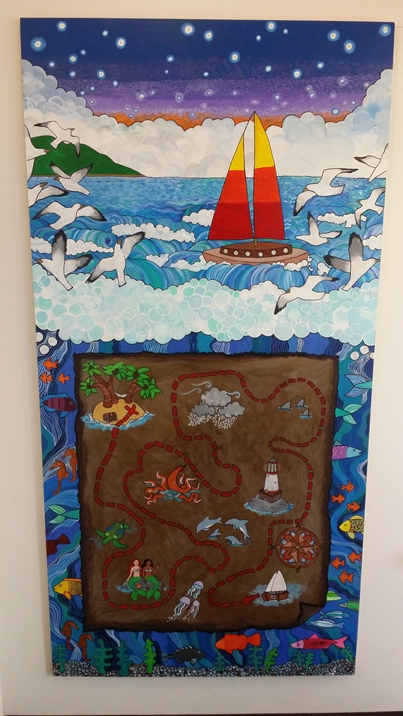
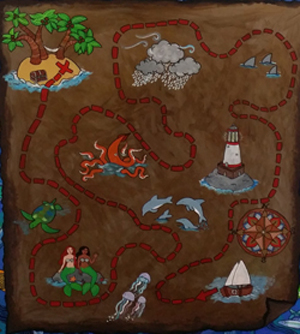
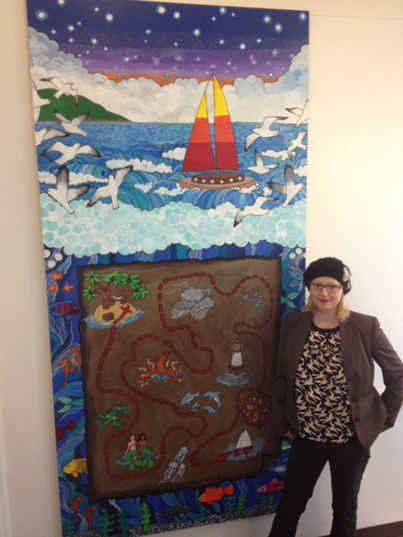
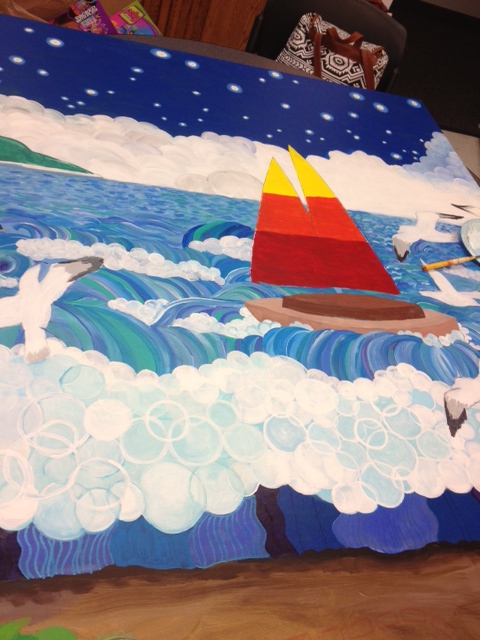
The mural created by some of the girls in our mentoring programs, led by artist Manda Severin, represents something very similar to this make-believe journey. They didn’t go on an actual boat, but the mural makes me think about the journeys we take at each phase of our lives and all the symbolism that can be found in a painting of an ocean.
Think about it: an ocean is a deep and mysterious place under the surface, but when you look at it from above, it is just a beautiful expanse of blue water and sparkly splashes and rolling waves. Looking at it from that viewpoint, it seems like an ocean is just water – miles and miles of water.
But we know that under the surface you can find all sorts of life. You might find turtles or fish or living coral. If you are lucky, maybe you’ll meet a mermaid or merman. If you travel close to shore you might see a lighthouse and cliffs and rocky shoreline. If you dive very deep, you might find larger sea creatures, both gentle and fierce, moving through the deep, dark depths.
It’s kind of like stretches of our lives. If we just look at what things appear to be on the surface, it can seem like lots of sameness – like the stretches of blue water of the ocean. If we look below, though, we find all sorts of things going on. On my particular journeys at various times of my life, I have met lots of interesting friends and companions (like the turtles and mermaids and jelly fish in the mural), weathered a few horrible storms, and been very grateful for the markers along the way that helped me avoid wrecks and disasters (like the lighthouse and the compass).
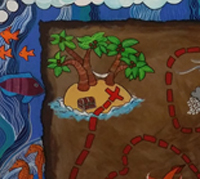
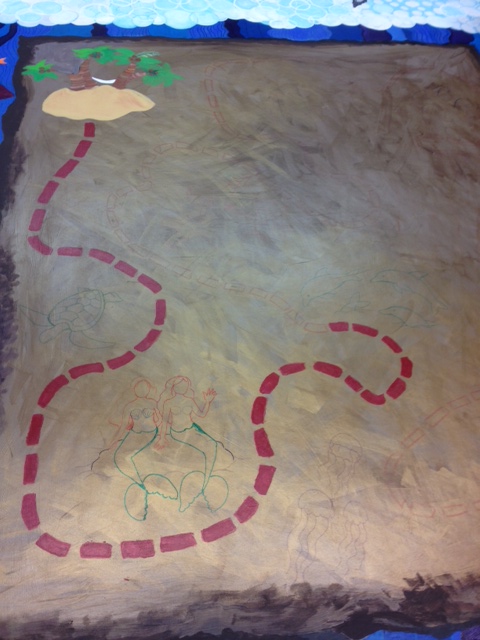
In the mural, the X marks the spot of the treasure, but the box is unopened. I like this image, because even though we might all venture through journeys similar to the one in this painting, we each need and hopefully find different “treasures”.
The journey of healing from anything painful has all of these elements: uncertain pathways, companions and friends, stormy periods, and resting spots when we need them. What I love about this mural is that it leaves a path of this journey so that others can follow and hopefully have an easier time of it. The fact that this was created by girls healing from abuse makes that part of the painting even more touching to me. I like the idea that they have created something that is both playful and significant, meaningful to their own journeys and to the journeys we all take, whether we have experienced abuse or not. We all journey through challenges and times of joy in our lives and this mural speaks to all of us in that way.
Have you decided yet what your journey might look like? Who your companions might be? What treasure you might find at the end?
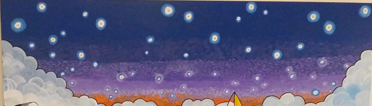
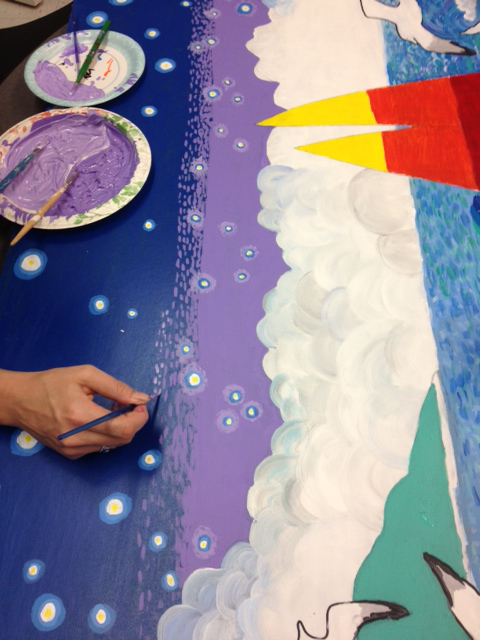
One last thing. At the top of the mural the purple sky is lit up with glowing stars in the shape of expanding circles and they seem to cast a blessing over the whole thing. I’d like to think those stars represent all those who watch over us and help us, over the girls who painted the mural, over all kids and teens healing from abuse. When I look up at the stars tonight, that thought will bring peace to my thoughts.
Thank you, artists of this mural, for sharing a little bit of your journeys with us and for leaving something beautiful behind at our center. May the stars watch over your journeys, tonight and every night, and may you always have companions to help you along your way.
This mural was painted by artist Manda Severin, with participation by five girls who are in treatment at the Children’s Advocacy Center (CAC). The girls helped choose the theme and picked the design, as well as being full participants in the painting process.
~~~~~~~~~~~~~~~~~~~~~~~~~~~~~~~~~
Manda Severin
The artist: Manda Severin is a true renaissance woman. She has a Master’s degree in Psychology and she has been an instructor at SOU for many years. She is also a very talented artist and musician. She is available to paint murals for individuals or businesses and she can be reached at juniperbryn@gmail.com
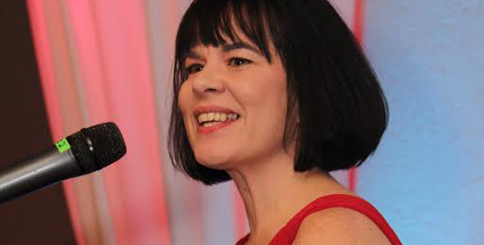
CAC Executive Director, Tammi Pitzen, “on stage” at the 2014 Winter Fundraising Gala
By Tammi Pitzen
As a young child I always dreamed that I would do something great with my life. Not the “you do good work kind of thing”, but the grandiose Hollywood kind of thing. I was never sure what that would be — but was certain that it would happen.
When I hit my forties, I began to re-evaluate whether I was going to do any great thing. I began playing back in my mind the events that impacted me the most and really looking to see if I could recreate those moments and turn them into the big grandiose thing.
Here is what I learned:
1) First and foremost, grandiose things are over rated. They tend to come big, but fade quickly. I decided that I wanted my “big thing” to come in small unnoticed steps that linger for a life time.
2) We really can accomplish so much more whenwe work together, than when we try to go it alone. This is true in every situation that I can think of. In fact, I can not think of one exception.
3) Every single day you should dance like there is no one watching. Seriously. I learned this from watching my five year old son. He is happiest when he is dancing. And soon I find myself wanting to dance with him and then, no matter what mood I started with, I always end up happy. When I look around, everyone within eyesight is also happy and laughing.
4) You should not worry about a legacy. Worry about what you are doing right now. What you do now is what matters. What are you doing now that matters?
5) Terrible awful things happen to the best people. It really isn’t about what is fair or what is right. It is about what you do next. Do you choose to stay exactly where the terrible awful thing left you or do you choose to rise above and beyond?
6)It is not a sign of weakness to ask for help. It is a sign that you are human. It really goes back to what we can accomplish together versus what we can do alone.
7)Never underestimate the small act of kindness and the impact that it can have on a person.
So many people will read this and think that I have let go of my childhood dream of doing something grandiose. I may never make it to Hollywood. However, I am doing “BIG” things.
I work quietly and sometimes loudly on behalf of small, vulnerable people.
What kind of world would we live in if every person’s “Big” thing was taking care of children?
Many people will read this and I think, “I can’t do that. I can’t see what you see.” The truth of the matter is that everyone is seeing it. The trick is to recognize what you are seeing. Reference the above list and look at point number two. And I ask again, “What kind of world would we live in, if every person’s “big” thing was to act on behalf of child abuse victims.”
What if we all worked to give a “BIG” voice to those who are unheard?
Just over a week ago we lost a family friend to a heroin overdose. A drug that was rarely found in the mainstream when I was growing up is now extremely common in high schools, Middle American neighborhoods and even Wall Street. We have a major epidemic going on and it is out of control. This one will eventually touch each and every one of us if we do not get a handle on it.
The use of heroin is being fueled by the exploding abuse of prescription pain medications such as Vicodan, Percocet and Oxycontin. The medical establishment has gotten wise to this and has made it more difficult to get these medications by prescription. People who have become hooked on them are now finding they are expensive to buy on the street. They turn to heroin, which is a much cheaper alternative. Unfortunately, heroin is laced with many other things. Most recently a very powerful drug called Fentanyl has been added resulting in multiple deaths from accidental overdoses.
We are losing our youth to this horrible epidemic. It is frightening and incredibly tragic. What can we do to turn this around?
Awareness is the first step. We need to recognize that this is a problem for all of us. Then we need to look at the bigger picture. Why are our children turning to drugs in the first place? There are many theories out there. The one that seems most plausible to me is that our society has become very complicated. Perfection is being paraded across our media screens. We have instant critiques on social media and for many of us our lives seem to be moving fast and out of control. This causes people to numb out and turn to things such as food, medication, and alcohol and of course, drugs.
As a parent, what can you do?
• I see parents out with their children more often than not, totally focused on their cell phones. It is disheartening. Get your children outside. Step away from your phones. Step away from your computers and be there to have fun and speak with your children, and when they talk to you, listen.
• Eat healthy. It is essential for mental health that we eat a healthy diet. Fruits, vegetables, lean protein and avoidance of processed foods are a must. Children follow by example. It is important that we model good behavior for our kids. When they see you stress eating, they will stress eat. When they see you eating healthy, they will eat healthy.
• Exercise. It boosts endorphins (those feel good chemicals) and teaches children healthy habits. It also is an important tool for handling stress.
• Most importantly, love your children and help them to understand that perfection is an illusion. It does not exist. They do not need to be the star on the soccer team or a Harvard graduate to deserve your approval. They need to know that they are worthy of being loved regardless of what they achieve. The key is that they realize they are enough.
We all fall and we all fail. Be there to listen and nurture and console, but let them fail. This is how we learn.
There is no guarantee in life. And, drug abuse can occur in any family. Believe me, I know. However, if we are able to have children who learn how to cope with anxiety and fear in healthy ways and who feel loved and secure, I think that we will see many of the problems start to diminish. It is time as individuals that we take control and these simple steps can be very powerful.
Start today. All of our children and the health of our society depend on it.
Dr. Miller is board-certified in Internal Medicine, is a member of the American College of Physicians, Oregon Medical Association and Jackson County Medical Association and is widely published. Her most recent book is “The Smart Woman’s Guide to Midlife and Beyond: A No-Nonsense Approach to Staying Healthy After 50”. Dr. Miller is currently featured on Podcasts at STR8 UP, Health Talk for Teens. You can also see her Monday and Tuesday nights at 6 PM on Newschannel 5 KOBI-NBC where she is the medical expert for “Doctors on Call” and “Focus on Health.”Also check out her columns in the Grants Pass Daily Courier and Lifescript.com. Her blogs can be found at smartwomanshealth.com.
In January and February, an artist named Manda Severin helped some of the girls who come to our center paint a beautiful mural. This, like all creative processes, began with a few simple things: paint, a canvas, brushes, ideas and thoughts, and a few questions.
What type of adventure would you like to take? What kind of journey are you on? What journey are we all on?
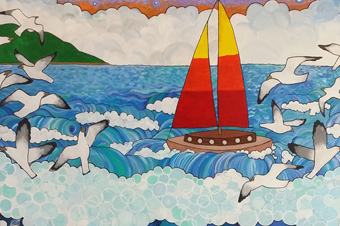
What flowed from these general ideas was a painting with literal images of flowing water, of ocean waves and birds. I got a glimpse of the mural before it was finished. The top half of the mural is bright with colors from the sea shore – blues and greens and a brilliant red-orange-yellow sailboat floating in the middle. The puffy clouds and bright stars in the sky mirror the white foam bubbling at the shore.
I am captivated by the images and want to get on that sailboat and see where it would take me.
But my eye is drawn to the image on the bottom half of the mural. This section is an earthy brown, a grounding color that compliments the bright movement of the ocean above it. A bright red dotted path starts at an island and travels down, in a curving pattern, around outlines of a turtle and mermaids, ending someplace in the middle of the space.
I wonder what is there?
The mural is not quite finished, so I will have to wait to see what treasure is found there, but it has me thinking. Will the path end here? Will the treasure be something expected, or something surprising? Will we get to see the treasure, or will we be left guessing about what type of treasure can be found in this magical place? Will each viewer of the mural get to decide on their own “treasure”, or will we all enjoy the same treasure?
I love this piece because it is so similar to life, with all of its twists and turns and surprises, the moments when we get to frolic with the sea turtles and the days when we feel lost on a path that doesn’t seem to have an end. The mural is both playful and a bit mysterious, and it invites me to look at my life with a bit more playfulness and lightheartedness.
The journey we are all on can be pretty hard sometimes, and the journey of healing from painful things can feel unbearable at times. But if we keep going – “just keep swimming” as Dori says in a famous sea-based movie – we can know that there is always treasure to be found and unknown adventures just around the corner. Just like life, this mural in its unfinished state invites me to keep going … to follow the dots and explore just a bit more.
I look forward to seeing it in its finished state. Stay tuned.